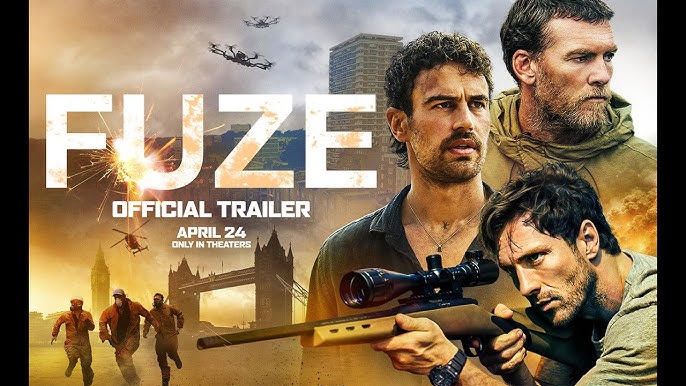
Ticking Clock Chaos: A Comprehensive Review of ‘Fuze’ (2025)
The heist genre is built on the foundation of the “perfect plan,” but in David Mackenzie’s Fuze (2025), perfection is discarded in favor of pure, unadulterated urban chaos. Reuniting with his Outlaw King star Aaron Taylor-Johnson, Mackenzie—the director behind the Academy Award-nominated Hell or High Water—trades the dusty plains of Texas for the rain-slicked, high-stakes streets of London.
Fuze is a high-concept thriller that masterfully intersects two diametrically opposed operations: a delicate bomb disposal and a violent bank robbery. Having premiered at the 2025 Toronto International Film Festival (TIFF) and hitting wide theatrical release in early 2026, the film positions itself as a “no-bullshit” throwback to the muscular British crime cinema of the early 2000s.
Movie Overview: ‘Fuze’ (2025)
| Category | Details |
| Director | David Mackenzie |
| Lead Cast | Aaron Taylor-Johnson, Theo James, Sam Worthington, Gugu Mbatha-Raw |
| Genre | Crime / Action / Thriller |
| Runtime | 96 Minutes |
| Release Date | April 3, 2026 (UK) / April 24, 2026 (US) |
| Cinematographer | Giles Nuttgens |
| Studio | Sky Cinema / StudioCanal / Saban Films |
Full Plot Synopsis: The Dead Zone
The narrative of Fuze is set in motion by a literal relic of history. During a massive construction project in central London, workers unearth a five-hundred-pound unexploded World War II ordnance. The discovery triggers a massive security protocol, forcing the Metropolitan Police to establish a “dead zone”—a complete evacuation of several square blocks in a high-traffic district.
Enter Major Will Tranter (Aaron Taylor-Johnson), a stoic Army EOD (Explosive Ordnance Disposal) specialist. Tranter is tasked with the painstaking job of disarming the fuse before the bomb can be safely moved. While the police, led by Chief Superintendent Zuzana (Gugu Mbatha-Raw), focus on the logistical nightmare of clearing the area, the city becomes eerily quiet.
This silence is exactly what Karalis (Theo James) has been waiting for. A mastermind with a volatile edge, Karalis leads a seasoned heist crew—including the heavy-hitting “X” (Sam Worthington)—into the heart of the evacuated zone. Their target is a secure bank vault that would normally be impossible to breach under standard police surveillance.
The film operates on a dual-timeline structure, cross-cutting between Tranter’s sweat-soaked attempts to neutralize the bomb and Karalis’ team smashing through the bank’s defenses. As the “fuse” on the bomb gets shorter, the tension within the heist crew begins to boil over. The third act reveals a deeper connection between Tranter and the robbers, stemming from their shared military past in Afghanistan, turning a simple robbery into a deadly game of chess where the bomb is both a threat and a tactical shield.
Detailed Critique: Momentum Over Depth
Direction and Visuals
David Mackenzie and his longtime cinematographer Giles Nuttgens excel at creating a sense of “tactile tension.” The camera work in the vault is claustrophobic and dirty, capturing the physical toll of the heist. In contrast, the scenes involving the bomb disposal are shot with a clinical, static precision that makes every turn of a wrench feel like a life-or-death decision. Mackenzie understands that in a 96-minute movie, there is no time for filler; every shot serves to tighten the proverbial noose.
Performances
Aaron Taylor-Johnson delivers a grounded, physical performance. He portrays Tranter not as an action hero, but as a technician under immense psychological strain. Theo James, continuing his streak of charismatic “bad boy” roles, is the film’s electric pulse. His Karalis is unpredictable and dangerous, providing a necessary contrast to the professional calm of the military units. Sam Worthington offers solid support as the heist’s enforcer, though his role is more traditional than the central duo.
Screenplay and Sound
The screenplay by Ben Hopkins is a lean machine. It avoids the long-winded monologues common in the genre, opting instead for professional shorthand and procedural detail. The sound design is the film’s secret weapon; the contrast between the absolute silence of the evacuation zone and the deafening roar of industrial drills creates a sonic landscape that keeps the audience off-balance. Tony Doogan’s industrial score hums in the background like a live wire, never letting the pulse drop.
Strengths & Weaknesses
Strengths
-
The Premise: Using a WWII bomb evacuation as a “smokescreen” for a heist is a brilliant, grounded concept that feels uniquely British.
-
Pacing: At just over 90 minutes, the film is incredibly propulsive. It respects the audience’s time and never lingers on unnecessary subplots.
-
Technical Authenticity: The attention to detail regarding EOD protocols and vault-cracking techniques adds a layer of realism that elevates the stakes.
Weaknesses
-
Character Backstory: While the ” Afghanistan connection” adds flavor, it feels somewhat under-explained, leaving the audience wanting more depth regarding the characters’ shared history.
-
The Ending: A late-film “twist” regarding the bomb’s status has divided critics, with some finding it a bit too convenient for the plot’s resolution.
Final Verdict
Fuze (2025) is a masterclass in tension. It doesn’t try to reinvent the heist film; instead, it polishes the mechanics of the genre to a mirror finish. While it may lack the emotional weight of David Mackenzie’s earlier dramas, it succeeds entirely as a visceral, high-stakes thriller. For fans of Heat, Thief, or The Town, Fuze is an essential addition to the modern crime canon.
Final Score: 7.8/10