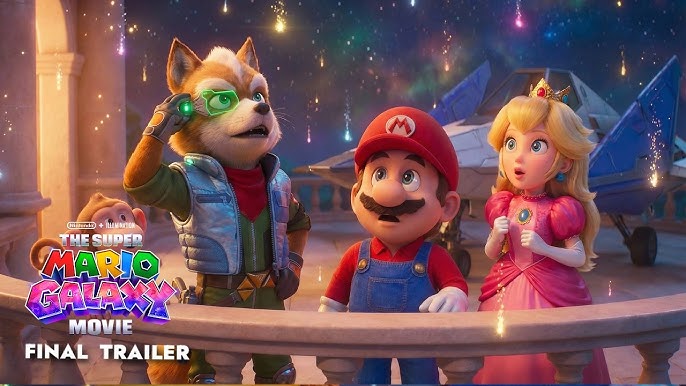
The Super Mario Galaxy Movie Review: A Cosmic Spectacle That Reaches for the Stars
Following the seismic success of 2023’s billion-dollar blockbuster, Nintendo and Illumination have returned to the stratosphere with The Super Mario Galaxy Movie (2026). Directed by the returning duo of Aaron Horvath and Michael Jelenic, this sequel pivots from the terrestrial charm of the Mushroom Kingdom to the gravity-defying wonders of deep space.
While the first film focused on origin stories and brotherly bonds, Galaxy aims for an operatic scale. It is a technical marvel that captures the whimsical physics of its namesake video game, though it occasionally prioritizes breathtaking set pieces over narrative depth. For fans of the franchise, however, it is a high-octane celebration of Nintendo’s most imaginative era.
Film Profile: Cast, Crew, and Technical Data
| Feature | Details |
| Title | The Super Mario Galaxy Movie |
| Release Date | April 1, 2026 (USA) |
| Directors | Aaron Horvath, Michael Jelenic |
| Screenwriter | Matthew Fogel |
| Voice Cast | Chris Pratt, Anya Taylor-Joy, Charlie Day, Jack Black, Brie Larson, Benny Safdie, Donald Glover |
| Runtime | 98 Minutes |
| Production Companies | Nintendo, Illumination |
| Distributed By | Universal Pictures |
Full Plot Synopsis: A Race Against Cosmic Chaos
The story picks up shortly after the events of the first film. Peace has returned to Brooklyn and the Mushroom Kingdom, but a new threat emerges from the stars. Bowser Jr. (Benny Safdie), seeking to outshine his imprisoned father’s legacy, spearheads an assault on the Comet Observatory. During the siege, he kidnaps the ethereal Princess Rosalina (Brie Larson) and her fleet of Lumas, intending to harness their “Star Bits” to power the Boomsday Machine—a weapon capable of rewriting the fabric of the universe.
A lone, gluttonous Luma manages to escape to the Mushroom Kingdom, finding Mario (Chris Pratt), Luigi (Charlie Day), and Princess Peach (Anya Taylor-Joy). The group, joined by the adventurous Toad (Keegan-Michael Key) and their new dinosaur ally Yoshi (Donald Glover), embarks on an interstellar voyage aboard a makeshift starship.
The journey takes them through iconic locales, including the Honeyhive Galaxy and the Good Egg Galaxy, where they must master shifting gravity to survive. Along the way, they encounter a “reformed” but still chaotic Bowser (Jack Black) in a celestial prison, leading to an uneasy alliance. The climax culminates in a reality-warping battle at the center of the universe, where Mario must take a leap of faith that goes beyond anything he learned in Brooklyn.
Detailed Critique: Analyzing the Cinematic Expansion
Direction and Visual Innovation
Horvath and Jelenic have successfully translated the “spherical gravity” of the 2007 Wii masterpiece into a cinematic language. The direction is dizzying in the best way possible; the camera loops and dives through space, making the audience feel the weightlessness of the environment. Illumination Studios Paris has pushed its rendering capabilities to the limit, creating nebulae and star-fields that are vibrant, textured, and deeply immersive.
Performances: New Additions and Returning Favorites
-
Jack Black as Bowser: Once again, Black is the MVP. His portrayal of a defeated, slightly pathetic, yet still menacing Bowser adds a layer of “villainous pathos” that the film desperately needs.
-
Brie Larson as Rosalina: Larson brings a calm, stoic authority to Rosalina. While the character is largely a “damsel” in this outing, her backstory—hinted at through beautifully animated vignettes—provides the film’s most emotional beats.
-
Benny Safdie as Bowser Jr.: Safdie voices the young antagonist with a frantic, high-pitched energy that makes him a perfect foil to the more stoic heroes.
The Screenplay and Pacing
Matthew Fogel’s script is a relentless “Easter egg” delivery system. While this is a delight for hardcore gamers—featuring cameos from Fox McCloud and deep-cut references to Super Mario Sunshine—the actual character development is thin. Mario and Luigi’s relationship, the heart of the first film, is sidelined in favor of the larger ensemble and the spectacle of the galaxies.
Soundtrack and Composition
Brian Tyler returns to the podium, blending Koji Kondo’s classic motifs with Mahito Yokota’s sweeping orchestral scores from the Galaxy games. The music is grander and more symphonic than the first film, ditching the 80s pop hits for a more timeless, epic feel that suits the space setting perfectly.
Strengths and Weaknesses
Strengths
-
Technical Achievement: The gravity-shifting animation is genuinely groundbreaking for the studio.
-
Action Choreography: The battle sequences are inventive, utilizing power-ups like the Bee Mushroom and Ice Flower in creative ways.
-
Fan Service: The film feels like a genuine “love letter” to the Nintendo Wii era.
Weaknesses
-
Narrative Pacing: At 98 minutes, the film moves so fast that emotional moments rarely have time to land.
-
Underused Protagonists: Luigi and Peach are frequently sidelined to make room for the massive cast of new characters.
Final Verdict
The Super Mario Galaxy Movie is a dazzling, hyper-kinetic sequel that proves the “Nintendo Cinematic Universe” has plenty of fuel left in the tank. While it lacks the narrative focus of its predecessor, it compensates with pure, unadulterated imagination. It is a must-see on the largest screen possible, serving as both a technical showcase for Illumination and a joyous expansion of the Mario mythos.