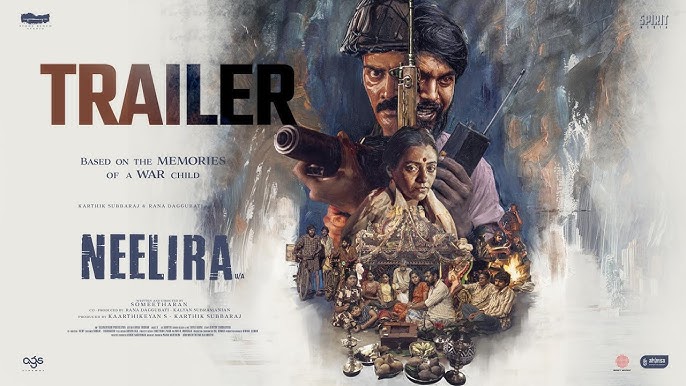
Neelira Movie Review: A Haunting, Minimalist Masterpiece of War and Humanity
The landscape of Tamil cinema has often grappled with the complexities of the Sri Lankan Civil War, but few films have approached the subject with the surgical precision and quiet intensity of Neelira. Directed by debutant Someetharan and backed by heavyweights Karthik Subbaraj (Stone Bench Films) and Rana Daggubati (Spirit Media), Neelira is a grueling yet essential exploration of trauma, survival, and the fragile threads of human connection in a zone of absolute despair.
Released on April 3, 2026, the film marks a significant departure from the loud, often didactic war dramas of the past. Instead, it offers a claustrophobic, 92-minute snapshot of a single night that encapsulates decades of systemic suffering.
Movie Information: Neelira (2026)
| Category | Details |
| Director | Someetharan |
| Cast | Naveen Chandra, Sananth, Roopa Koduvayur, Kapila Venu |
| Genre | War Drama / Period Thriller |
| Runtime | 92 Minutes |
| Release Date | April 3, 2026 |
| Language | Tamil |
| Production | Stone Bench Films, Spirit Media |
Full Plot Synopsis: A Night Under Siege
Set in Northern Sri Lanka in 1988, Neelira unfolds during the height of the civil conflict, specifically focusing on the presence of the Indian Peace Keeping Force (IPKF). The narrative is framed through the haunting memories of a child, now an adult, looking back at a pivotal night that redefined their family’s existence.
The story begins in a modest village home where a family is preparing for a wedding. Despite the looming shadow of war, there is a desperate attempt to cling to normalcy. The bride-to-be (Roopa Koduvayur) and her family are caught in the frantic final hours of preparation when their home is suddenly requisitioned by a unit of soldiers led by a weary, disciplined Captain (Naveen Chandra).
What follows is a high-tension “home invasion” drama where the invaders are not criminals, but state actors. The soldiers occupy the house to set up a tactical vantage point, effectively turning the wedding eve into a hostage situation. As the night progresses, the boundary between “protector” and “oppressor” blurs. The film meticulously tracks the psychological friction between the soldiers, who are far from home and increasingly paranoid, and the family, whose only weapon is their endurance.
The tension reaches a breaking point when an insurgent presence is detected nearby, forcing the family and the soldiers into a shared, terrifying proximity where one wrong move means certain death for everyone. The resolution is not found in a grand battle, but in a series of intimate, soul-baring confrontations that question the very utility of the war they are all trapped in.
Detailed Critique: Direction, Acting, and Visuals
Direction and Screenplay
Someetharan, making his directorial debut, displays a veteran’s sense of restraint. By narrowing the scope of a decades-long war to a single house over one night, he creates a microcosm of the entire conflict. The screenplay is lean, avoiding the “speechifying” that often plagues political cinema. Instead, the horror is found in the subtext—the way a soldier handles a kitchen utensil or the silent stare of a child watching their sanctuary be dismantled.
Performances
Naveen Chandra delivers perhaps the finest performance of his career as the Captain. He portrays a man who is legally in control but morally exhausted, embodying the internal conflict of a soldier following orders he no longer believes in.
Roopa Koduvayur is the emotional anchor of the film. Her character’s journey from bridal anxiety to raw, visceral survivalist instinct provides the film’s most harrowing moments. A standout scene involving her emotional breakdown is handled with such authenticity that it becomes difficult to watch. Sananth and Kapila Venu provide excellent support, with Sananth’s closing monologue serving as a poignant, stinging indictment of the cycle of violence.
Visuals and Sound
The cinematography by Selvaratnam Pratheepan is masterful. Using low-light photography and tight framing, he emphasizes the suffocating atmosphere of the occupied house. The camera often lingers on faces, capturing micro-expressions of fear and defiance.
The sound design by Tapas Nayak and the score by K are equally vital. The film uses silence as a weapon; the absence of sound in the Sri Lankan wilderness is more terrifying than the roar of gunfire. When the score does swell, it is mournful and atmospheric rather than manipulative.
Strengths and Weaknesses
Strengths
-
Tight Pacing: At 92 minutes, the film is incredibly focused, with no wasted frames or “filler” subplots.
-
Authenticity: The use of Jaffna Tamil dialects and the meticulous recreation of 1980s Sri Lankan rural life adds a layer of documentary-like realism.
-
Human-Centric Narrative: It avoids taking easy political sides, choosing instead to focus on the universal human cost of war.
-
Production Quality: The backing of Karthik Subbaraj ensures a high technical standard that elevates the indie-film sensibility.
Weaknesses
-
Intense Subject Matter: The unrelenting tension and grim atmosphere may make it a difficult watch for mainstream audiences seeking escapism.
-
Minimalist Scope: Viewers looking for a traditional “war movie” with large-scale action sequences may find the single-location setting restrictive.
Final Verdict: A Modern Classic of Tamil Cinema
Neelira is a profound, devastating work of art. It is a film that demands to be seen, not because it provides easy answers, but because it asks the right questions about empathy in the face of institutional violence. It stands alongside films like Kannathil Muthamittal as a vital piece of the Eelam Tamil cinematic canon, yet it carves its own path through its minimalist, thriller-adjacent execution.
Rating: 4.5/5 Stars