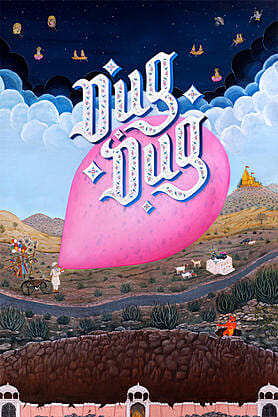
The Architect of Absurdity: Ritwik Pareek’s ‘Dug Dug’ (2026) and the Deconstruction of Faith
In the vast, often predictable landscape of Indian cinema, every so often a film emerges that defies categorization, choosing instead to exist in its own vibrant, hallucinatory reality. Dug Dug (2026) is precisely that anomaly. Directed by debutant Ritwik Pareek and backed by a powerhouse collective of executive producers including Anurag Kashyap, Vikramaditya Motwane, Nikkhil Advani, and Vasan Bala, the film arrived in Indian theaters on May 8, 2026, following a celebrated multi-year journey through the international festival circuit.
A psychedelic social satire rooted in the folklore of Rajasthan, Dug Dug is less a traditional narrative and more a rhythmic, sensory exploration of how myths are birthed, nurtured, and eventually monetized. It is a film that examines the “business of belief” with a gaze that is simultaneously irreverent and deeply observant.
Film Overview: Production and Release
| Feature | Details |
| Title | Dug Dug |
| Release Date | May 8, 2026 (India) |
| Director/Writer | Ritwik Pareek |
| Cast | Altaf Khan, Gaurav Soni, Yogendra Singh, Durga Lal Saini |
| Genre | Satire / Musical / Mystery |
| Runtime | 105 Minutes (1h 45m) |
| Cinematography | Aditya S. Kumar |
| Production Design | Ranjit Singh |
| Musical Score | Salvage Audio Collective |
Full Plot Synopsis: The Genesis of a God
Dug Dug is inspired by the real-life phenomenon of the “Bullet Baba” shrine in Rajasthan, where a motorcycle is worshipped as a deity. The film’s narrative begins with Thakur (Altaf Khan), a middle-aged man known more for his affinity for alcohol than any spiritual leaning. One neon-soaked night, while riding his moped—a colorful Luna—Thakur meets with a gruesome, surreal accident that leaves him dead and his bike at the bottom of a roadside ditch.
The following morning, the local police impound the motorcycle. However, in a turn of events that borders on the miraculous (or the mischievous), the bike disappears from the locked station and reappears at the exact site of the accident. Despite being chained, emptied of fuel, and guarded by weary constables Pyare Lal (Gaurav Soni), Badri (Yogendra Singh), and Manfool (Durga Lal Saini), the machine relentlessly returns to its master’s final resting place.
As word of the “self-motoring” bike spreads, the rural community of Dug Dug undergoes a transformation. What begins as a curiosity quickly snowballs into a full-blown religious frenzy. Thakur is posthumously elevated to “Thakur Sa,” a divine figure, and the roadside ditch is transformed into a shimmering shrine. In a sharp satirical twist, alcohol—Thakur’s lifelong vice—becomes the mandatory holy offering. The film tracks the rapid commercialization of this new faith, as local politicians, opportunistic priests, and even a fading royal family converge to claim a stake in the growing empire of the “Motorcycle God.”
Detailed Critique: A Visual and Auditory Rave
Direction and Screenplay
Ritwik Pareek makes one of the most audacious debuts in recent memory. His screenplay is minimalist in terms of dialogue but maximalist in its conceptual execution. Pareek treats the village as a living organism that reacts to the “miracle” with a mixture of desperate hope and cold calculation. His direction is confident, eschewing the “indie-realism” trope for a style that feels like a cross between a carnival and a fever dream.
Acting and Performance
The film intentionally lacks a singular “star,” choosing instead to use an ensemble of non-professional and character actors who blend seamlessly into the Rajasthani setting. Altaf Khan is mesmerizing in the opening sequences, capturing a tragicomic invincibility. The trio of policemen—Soni, Singh, and Saini—provide the film’s moral and comedic anchor. Their deadpan reactions to the escalating absurdity highlight the film’s central theme: that in a world governed by superstition, the most logical people are often the most sidelined.
Visuals and Cinematography
Cinematographer Aditya S. Kumar delivers a visual palette that is nothing short of intoxicating. The film is drenched in “Thakur’s colors”—vibrant pinks and electric blues. Through the use of wide-angle lenses and kinetic camera movements, the arid desert landscape is reimagined as a technicolor playground. The production design by Ranjit Singh further enhances this, using kitschy religious iconography and twinkling fairy lights to create a world that feels both ancient and neon-modern.
Sound Design and Score
The “Dug Dug” of the title refers to the rhythmic thumping of a motorcycle engine, and the Salvage Audio Collective turns this sound into the film’s heartbeat. The score is a pulsating mix of electronic beats and folk-inspired melodies that drive the film’s many montages. The sound design by Siddharth Dubey ensures that the motorcycle itself feels like a character, its mechanical wheezes and hums sounding like a strange, metallic prayer.
Themes: The Anatomy of Belief
The film serves as a potent allegory for the human condition and the structures of society:
-
The Commercialization of Hope: Pareek illustrates how quickly faith is hijacked by capitalism. The moment a miracle is identified, a souvenir shop is born.
-
Collective Delusion: Dug Dug explores how humans would rather believe in a magical machine than confront the messy reality of a man’s accidental death.
-
The Absurdity of Ritual: By replacing traditional offerings with alcohol, the film holds a mirror to the arbitrary nature of religious customs, suggesting that the “rules” of faith are often whatever the loudest voice dictates.
Strengths and Weaknesses
Strengths
-
Unique Aesthetic: A visual style that is entirely distinct from mainstream Bollywood or typical indie cinema.
-
Technical Excellence: The synergy between the cinematography, music, and editing creates a highly immersive experience.
-
Sharp Satire: It manages to critique religious fanaticism without feeling cynical or mean-spirited.
Weaknesses
-
Narrative Stagnation: In the second act, the film leans heavily on montages, which may feel repetitive to some viewers as the “mystery” takes a backseat to the “spectacle.”
-
Experimental Pacing: The 105-minute runtime is relatively short, yet the lack of a traditional protagonist-driven plot might test the patience of those accustomed to linear storytelling.
Final Verdict
Dug Dug is a triumph of vision over budget. It is a “visual rave” that manages to say more about the state of modern faith through its silence and its colors than many films do through hours of dialogue. Ritwik Pareek has not just made a movie; he has constructed a vibrant, humming monument to the bizarre beauty of human belief. It is a must-watch for anyone seeking a cinema that is bold, brave, and brilliantly weird.
Final Grade: A-