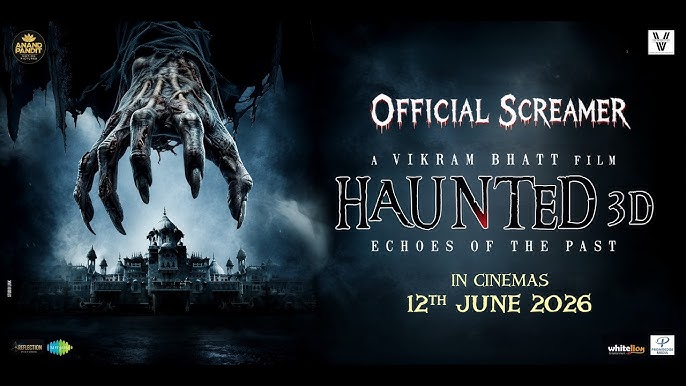
Haunted 3D: Echoes of the Past (2026) — A Detailed Structural and Cinematic Horror Analysis
The landscape of Indian gothic horror has long been anchored by the distinct stylistic identity of filmmaker Vikram Bhatt. Known for blending classic supernatural lore with stereoscopic technology, Bhatt returns to his signature domain with Haunted 3D: Echoes of the Past (2026). Produced by Anand Pandit, Rakesh Juneja, and Shwetambari Bhatt under the banner of Anand Pandit Motion Pictures, this installment functions as an ambitious continuation of Bhatt’s thematic fascination with isolated mansions, multi-generational curses, and redemption arcs driven by romantic devotion.
Targeting an audience that favors traditional jump scares and myth-driven narratives, Haunted 3D: Echoes of the Past represents an effort to merge old-school Bollywood horror sensibilities with modernized 3D visual effects. This analysis dissects the film’s narrative structure, artistic direction, technical parameters, and overall place in contemporary genre filmmaking.
Technical Specifications and Production Overview
Before diving into the narrative structure and thematic nuances, an overview of the production framework highlights the scope of this theatrical release.
| Metadata Attribute | Production Detail |
| Title | Haunted 3D: Echoes of the Past |
| Release Date | June 12, 2026 |
| Director | Vikram Bhatt |
| Lead Cast | Mimoh (Mahaakshay) Chakraborty, Chetna Pande, Shruti Prakash, Praneet Bhatt |
| Supporting Cast | Krutika Desai, Hemant Pandey, Gaurav Bajpai, Sunil Shakya |
| Writers | Vikram Bhatt (Story/Screenplay), Shweta Bothra (Dialogues) |
| Cinematographer | Naren A. Gedia |
| Runtime | 2 Hours 18 Minutes (138 Minutes) |
| Censor Certification | A (Adults Only) |
| Music Directors | Prateek Walia, Puneet Dixit |
| Production Design | Naushad Memon |
Full Plot Synopsis
The narrative follows Devadutt “Dev” Choudhary (Mimoh Chakraborty), a man seeking refuge from a fractured past by taking a solitary assignment to evaluate an isolated, sprawling mansion nestled deep within an Indian mountain range. Haunted by personal guilt, Dev hopes the isolation of the misty estate will offer emotional respite. However, the architecture itself acts as a container for historical suffering and active, malevolent entities.
Upon arrival, Dev experiences sensory distortions, auditory hallucinations, and shifting geometric spaces within the house. He discovers that the mansion belongs to an ancient family lineage marked by tragic violence. The central antagonist is the malevolent spirit of Vikrat Singh (Praneet Bhatt). Years prior, Vikrat met a violent end, but his mother, Mandara (Krutika Desai), utilized dark, esoteric rituals to anchor her son’s consciousness to the earthly realm, morphing his dead soul into an aggressive, territorial spirit.
Dev learns that the house holds a young woman named Sunehri (Chetna Pande) captive within its metaphysical boundaries. Sunehri is not a living occupant but a soul trapped by Vikrat’s spirit, forced to endure an endless cycle of psychological torment due to an obsession carrying over from Vikrat’s living days.
As Dev becomes more entangled with Sunehri’s plight, the hauntings escalate from standard apparitions to physical manifestations of terror. Assisted by localized lore from characters like Trilok (Hemant Pandey) and encountering secondary victims like Yamini (Shruti Prakash), Dev realizes that his presence in the mansion is not accidental. To free Sunehri and survive the structural trap, he must confront both Mandara’s ongoing dark magic and the full, unbridled rage of Vikrat’s spirit in a physical and metaphysical climax.
In-Depth Critical Critique
Themes and Narrative Foundations
Haunted 3D: Echoes of the Past leans heavily on standard gothic conventions: ancestral sin, the distortion of maternal love into something monstrous, and love acting as an emulsifier for spiritual liberation.
The most compelling thematic layer lies in the characterization of Mandara. Rather than presenting a generic haunting without an origin point, the screenplay frames the haunting as an active extension of grief. The transformation of a son into a monster via maternal desperation offers a psychological foundation that elevates the standard “haunted house” blueprint. However, the screenplay often sacrifices this psychological depth in favor of conventional genre tropes, relying on external conflicts rather than exploring the psychological deterioration of its characters.
Acting and Performance Analysis
-
Mimoh Chakraborty (Dev): Chakraborty delivers a measured performance, projecting the vulnerability of a man running from his own history. While he handles the physical demands of the action-heavy horror sequences adequately, his emotional transitions occasionally lack the nuance required for a deeply haunted protagonist.
-
Chetna Pande (Sunehri): Pande plays the trapped soul with an appropriate mix of ethereal melancholy and panic. Her chemistry with Chakraborty anchors the film’s romantic undercurrent, though the script limits her agency, frequently positioning her as a classic damsel in spiritual distress.
-
Praneet Bhatt (Vikrat Singh): As the primary antagonist, Bhatt brings a theatrical, aggressive energy to the screen. His performance relies heavily on body language and intense expressions, which suits the larger-than-life nature of an ancestral entity.
-
Krutika Desai (Mandara): Desai provides the film’s most memorable performance. She balances maternal agony with sinister intent, creating a genuinely unsettling presence whenever she appears in flashbacks or ritualistic sequences.
Direction and Visual Style
Vikram Bhatt’s direction demonstrates a strong familiarity with the spatial mechanics of horror. He utilizes the camera to maximize the depth required for 3D exhibition. Long, tracking corridors, sudden foreground movements, and deep-focus frames are designed to immerse the viewer in the oppressive atmosphere of the mountain mansion.
Cinematographer Naren A. Gedia employs a cold color palette dominated by slate blues, misty grays, and muted earth tones, contrasted sharply by the warm, aggressive ambers used during the ritual sequences. While the visual composition is polished, the reliance on sudden camera pans and recurring visual motifs occasionally makes the atmospheric tension feel formulaic.
Sound Design and Screenplay Structure
The sound design plays a critical role in generating tension, utilizing low-frequency ambient hums to build an underlying sense of dread. However, the musical score by Prateek Walia and Puneet Dixit occasionally overcompensates, using loud orchestral stings to force jump scares rather than allowing the silence and spatial depth to create natural tension.
Shweta Bothra’s dialogues are functional, prioritizing narrative clarity over subtext. The screenplay moves at a deliberate pace in the first half to establish the geography of the mansion, but compresses significant portions of the lore into heavy exposition dumps during the mid-section, slightly breaking the film’s pacing.
Key Strengths and Weaknesses
Strengths
-
Atmospheric Cinematography: Gedia’s camera work captures the isolation and scale of the mountain estate effectively, delivering strong visual depth for 3D presentation.
-
Memorable Antagonists: The performances of Krutika Desai and Praneet Bhatt provide the narrative with distinct, high-stakes conflict.
-
Pacing of Twists: The screenplay distributes its narrative reveals and ancestral histories evenly enough to sustain curiosity across the 138-minute runtime.
Weaknesses
-
Formulaic Scare Tactics: The film relies heavily on traditional jump scares and loud audio cues rather than sustained psychological tension.
-
Exposition-Heavy Dialogue: Significant elements of the plot and curse mechanics are explained through direct dialogue rather than visual storytelling.
-
Unconvincing Subplots: Minor characters and localized investigations occasionally slow down the primary conflict between Dev, Sunehri, and the supernatural forces.
Final Verdict
Haunted 3D: Echoes of the Past is a visually polished, systematically constructed gothic horror film that aligns closely with Vikram Bhatt’s established filmography. While it does not reinvent the genre mechanics or transcend its traditional tropes, it executes its formula with a clear understanding of theatrical scale and 3D space. Propelled by strong supporting performances from Krutika Desai and Praneet Bhatt, it offers an engaging viewing experience for seasoned enthusiasts of Indian supernatural cinema, even if it lacks the structural novelty to reshape modern horror benchmarks.