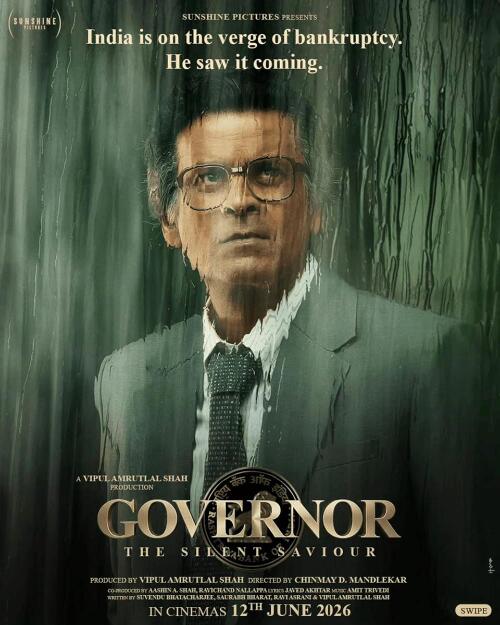
The Ledger of Power: A Deep-Dive Review of ‘Governor: The Silent Saviour’ (2026)
The geopolitical or military thriller has long been a staple of modern cinema, relying on tactical combat and high-stakes espionage. However, director Chinmay Mandlekar shifts this paradigm to the sterile, high-pressure corridors of New Delhi and Mumbai in Governor: The Silent Saviour (2026). Produced by Vipul Amrutlal Shah under Sunshine Pictures, this 122-minute Hindi-language political drama attempts a rare cinematic feat: transforming dry macroeconomic policy and balance-of-payments logistics into a ticking-clock narrative event.
Released theatrically on June 12, 2026, the film dramatizes India’s harrowing 1991 economic crisis. Rather than celebrating battlefield heroes, it positions an analytical bureaucrat at the epicenter of a nation facing systemic collapse. The result is a film that successfully captures institutional dread but grapples with narrative reductionism, occasionally trading complex historical collaboration for simplified cinematic hagiography.
Critical Film Overview
| Attribute | Details |
| Title | Governor: The Silent Saviour |
| Release Date | June 12, 2026 |
| Director | Chinmay Mandlekar |
| Producers | Vipul Amrutlal Shah (Sunshine Pictures) |
| Screenplay | Saurabh Bharat, Ravi Asrani, Vipul Amrutlal Shah |
| Lead Cast | Manoj Bajpayee, Adah Sharma, Noushad Mohamed Kunju, Madhoo, Paritosh Sand |
| Runtime | 122 Minutes |
| Genre | Political Drama / Economic Thriller / Biography |
| Language | Hindi (With English Subtitles) |
Full Plot Synopsis: A Nation on the Financial Brink
The narrative opens in the sweltering, anxious summer of 1991. The external economic shocks of the Gulf War have caused global oil prices to skyrocket, while foreign remittances have completely dried up. India’s foreign exchange reserves have plummeted to a perilous low of less than $1.2 billion—barely enough to sustain two weeks of essential imports. The sovereign nation stands on the precipice of an unprecedented debt default, a catastrophic scenario that would instantly obliterate its international credit standing and global fiscal autonomy.
Amidst intense political volatility, fractured parliamentary coalitions, and administrative paralysis, the brilliant but low-profile career bureaucrat A. Ramanan (Manoj Bajpayee) is appointed as the Governor of the Reserve Bank of India (RBI). Heavily based on the real-life actions of the late RBI Governor S. Venkitaramanan, Ramanan’s weapons are not physical armaments, but international ledgers, economic balance sheets, and a profound understanding of global institutional monetary systems.
Finding the policy-making framework between the central bank and the executive government frozen by ideological division and bureaucratized delay, Ramanan conceives a radical, covert, and politically dangerous maneuver. He proposes secretly mortgaging 47 metric tons of India’s national gold reserves to the Bank of England and the Bank of Japan to secure an emergency $400 million structural adjustment loan.
The second half of the film functions as a localized, high-stress procedural. The narrative tracks the classified logistics of packing, moving, and airlifting actual gold bullion from highly secure institutional vaults onto international aircraft. Concurrently, Ramanan must fight an escalating psychological war against internal leaks, skeptical political figures, and an increasingly inquisitive national press corps led by an ambitious investigative reporter named Pallavi (Adah Sharma). Ramanan must finalize the emergency transaction before a midnight international debt-clearing deadline, balancing state secrecy against the demands of a democratic system.
Detailed Critique: Direction, Screenplay, and Ideological Undertones
Performance Analysis: Bajpayee’s Quiet Steel
Manoj Bajpayee anchors Governor: The Silent Saviour with a performance of extraordinary emotional and physical restraint. Eschewing the theatrical, explosive dialogue delivery that frequently characterizes Indian political cinema, Bajpayee relies on micro-expressions, heavy silences, and the physical slump of a man bearing immense institutional weight. His Ramanan is a cold, calculated pragmatist trying to navigate the transition of an entire subcontinent away from closed-economy restrictions toward an integrated free-market highway.
Unfortunately, this disciplined acting occurs within a relative narrative vacuum. The supporting cast—including Noushad Mohamed Kunju and Paritosh Sand—are largely relegated to one-dimensional, expository archetypes. They exist either to state alarming financial metrics or to panic in boardrooms, leaving Bajpayee with very few complex intellectual stalemates or narrative equals to bounce off of. Adah Sharma’s portrayal of the investigative journalist Pallavi suffers from broad, caricature-like strokes, lacking the sharp internal drive necessary to make the adversarial press dynamic genuinely compelling.
Screenplay and Technical Execution
The screenplay—co-written by Saurabh Bharat, Ravi Asrani, and Vipul Amrutlal Shah—deserves credit for making dense fiscal concepts accessible to a broad audience. Terms such as sovereign credit ratings, balance of payments, and emergency gold pledges are cleanly integrated into the dialogue without entirely grinding the dramatic pacing to a halt.
Visually, cinematographer Vishal Sinha effectively captures the analog, shadow-filled administrative offices of New Delhi and Mumbai. The muted, corporate color palette underscores the loneliness of the central bureaucrat. The mid-film editorial shift by Meghna Manchanda Sen and Sanjay Sharma successfully accelerates the pacing from a corporate boardroom drama to a ticking-clock logistics thriller during the gold transport sequences.
However, this structural pivot reveals a distinct lack of confidence in the core intellectual material. Rather than trusting the natural tension of high-stakes macroeconomic negotiations, director Chinmay Mandlekar relies on a hyper-dramatic, loud background score to artificially inject adrenaline into scenes primarily involving administrative paperwork and heavy transit trucks.
The Problem of Historical Reductionism
The most significant limitation of Governor: The Silent Saviour lies in its structural and ideological reductionism. By framing a highly collaborative, multi-institutional economic salvation as the legend of a solitary “lone ranger,” the film dramatically flattens the complex history of 1991. The structural rescue of the Indian economy was an intricate, collaborative effort involving various ministries, economists, and political leaders. By rendering Ramanan as a singular savior operating almost entirely in isolation, the script compromises its historical authenticity for standard cinematic tropes.
Furthermore, the film frames historical events through a contemporary lens that occasionally positions democratic debate as an institutional liability. The free press is frequently depicted as a dangerous hindrance to state survival rather than an essential mechanism of democratic accountability. By explicitly comparing the central bank to a suffering, silent mother and contrasting political discourse with the quiet, unchecked resolve of a single technocrat, the movie subtly champions centralized authority over institutional collaboration.
Strengths and Weaknesses
Strengths
-
Manoj Bajpayee’s Masterclass: A highly disciplined, internal performance that avoids the melodramatic traps of traditional commercial biopics.
-
Accessible Macroeconomic Exposition: Successfully translates complex financial crisis mechanics into a clear, engaging cinematic narrative.
-
Immersive Production Design: The cold, dimly lit 1990s bureaucratic spaces accurately convey the analog pressure of the era.
Weaknesses
-
Flat Supporting Characters: Expository, thin writing leaves the central protagonist without any meaningful intellectual counterweights.
-
Melodramatic Tonal Shifts: Abandoning procedural realism in the third act in favor of loud, manipulative background scoring and artificial suspense.
-
Ideological Over-simplification: Flattening a collaborative, systemic economic turnaround into a black-and-white narrative that views democratic oversight with cynicism.
Final Verdict
Governor: The Silent Saviour is an ambitious and well-crafted, yet inherently flawed addition to India’s burgeoning landscape of institutional and bureaucratic dramas. While it excels when detailing the quiet steel of Manoj Bajpayee and the technical mechanics of crisis management, it is ultimately limited by its weak supporting characterization and its reductive view of historical collaboration. It remains an engaging, highly watchable experience for audiences fascinated by economic history, but it falls short of being the definitive, nuanced cinematic document of India’s structural transformation.