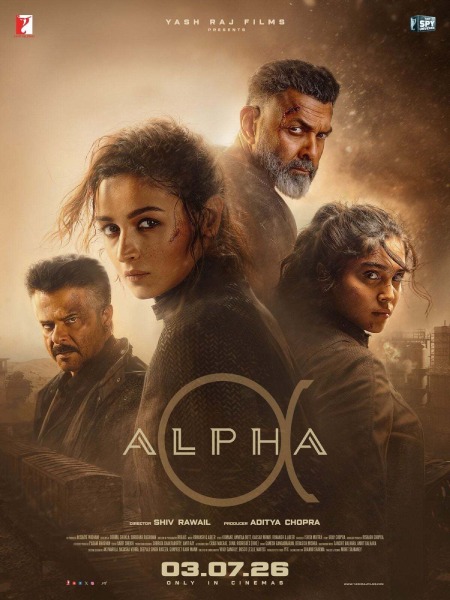
Alpha (2026) Movie Review: A Sleek, Kinetic, Yet Form-Driven Addition to the YRF Spy Universe
The expansion of cinematic shared universes remains a dominant force in global entertainment, and Yash Raj Films has aggressively positioned its espionage franchise as a cornerstone of Indian blockbuster cinema. The seventh entry in the franchise, Alpha (2026), represents a pivotal structural shift. Directed by Shiv Rawail—who previously earned international acclaim for the historical drama series The Railway Men—Alpha steps away from the veteran, male-dominated star vehicles of Tiger, Pathaan, and War to deliver the franchise’s first female-led spy thriller.
Clocking in at a tight 2 hours and 20 minutes, the film positions A-list star Alia Bhatt alongside rising action talent Sharvari in a high-stakes origin story designed to challenge the traditional boundaries of Hindi action cinema. However, while Alpha excels in technical precision and physical stunt work, it struggles to completely liberate itself from standard Hollywood tropes and the structural formulas inherent to the espionage genre.
Technical Specifications and Production Overview
To understand the scale of Alpha, it is essential to look at the architectural framework established by Yash Raj Films for this 2026 tentpole release.
| Attribute | Details |
| Title | Alpha |
| Release Date | July 3, 2026 (Worldwide) |
| Director | Shiv Rawail |
| Screenplay | Shridhar Raghavan, Soumil Shukla |
| Story | Uday Chopra |
| Producer | Aditya Chopra |
| Production House | Yash Raj Films |
| Runtime | 140 Minutes (2 Hours 20 Minutes) |
| Language | Hindi (Dubbed in Tamil and Telugu) |
| Cinematographer | Rubais |
| Action Directors | Craig Macrae, Sunil Rodrigues |
Full Plot Synopsis
The narrative architecture of Alpha functions primarily as a gritty origin story centered around genetic engineering and institutional betrayal. The story begins following the 1999 Kargil War, when Colonel Fateh Singh Lakhawat (Bobby Deol), alongside Lieutenant Colonel Vikrant Kaul (Anil Kapoor), initiates a covert Indian Army super-soldier project code-named “Alpha.” Years later, Vikrant’s pregnant wife, Janaki, is diagnosed with a fatal congenital heart disease. In a desperate bid to save her life, Vikrant secretly steals and administers a vial of the experimental Alpha serum, which has highly advanced regenerative properties. While the serum keeps Janaki alive long enough to give birth to twin daughters, the long-term toxicity proves fatal, and she dies shortly after childbirth.
Following this breach of protocol, the official Alpha program is shut down by the military, and Fateh is demoted. However, determined to realize his vision, Fateh collaborates with Dr. John Verghese to abduct one of the newborn twins, who inherited the active Alpha serum in her bloodstream. He deceives Vikrant into believing that both his wife and child perished during the delivery. Naming the abducted child Sita (Alia Bhatt), Fateh raises her in complete isolation at a highly fortified, secret facility in Rajasthan. He conditions her to be a lethal weapon, completely detached from personal ties. Meanwhile, the remaining twin, Durga (Sharvari), is raised separately, living an ordinary life entirely unaware of her sister’s existence.
Twenty-four years later, in 2026, Sita learns the dark truth about her stolen childhood and the illicit nature of Fateh’s operation via Dr. Verghese. Breaking free from her psychological conditioning, she goes rogue, systematically assassinating the key military officials and scientists involved in the project before obliterating Fateh’s research facility. Her destructive path across the globe attracts the immediate attention of the Research and Analysis Wing (R&AW), now led by Chief Vikrant Kaul. When Vikrant confronts Fateh, he discovers that the rogue assassin is his long-lost biological daughter.
Vikrant tracks down Durga to secure her safety, but Sita arrives shortly after, resulting in a brief, volatile confrontation between the twin sisters before they are ambushed by Fateh’s mercenary forces. Escaping the onslaught with temporary tactical assistance from Kabir Dhaliwal (Hrithik Roshan), the sisters form an uneasy alliance. The narrative shifts toward a high-stakes, multi-layered third act when Fateh captures Vikrant at a heavily guarded military base.
In a final, tense confrontation, Fateh reveals his ultimate deception: his true identity is Major Zarrar Khan, an undercover Inter-Services Intelligence (ISI) operative who infiltrated the Indian Army decades prior to steal the completed Alpha serum. Working in unison, Sita and Durga utilize their synchronized tactical training and enhanced physical abilities to dismantle Zarrar’s forces. Sita ultimately executes Zarrar, ending the illicit program for good. The film concludes with a reunited Vikrant offering both daughters a choice: return to civilian life or utilize their unique abilities to serve as official primary assets within the broader YRF Spy Universe alongside Tiger, Pathaan, and Kabir.
Detailed Critical Analysis
Themes: Agency, Autonomy, and Institutional Control
At its core, Alpha attempts to interrogate the heavy cost of state-sanctioned conditioning and stolen autonomy. The thematic weight rests on how both Sita and Durga navigate their existence as physical biological assets. The screenplay, penned by Shridhar Raghavan and Soumil Shukla, touches heavily upon the patriarchal dynamics governing espionage institutions. Fateh represents the absolute corruption of paternalistic state authority that views human life as property, while Vikrant symbolizes the bureaucratic establishment attempting to correct past failures.
However, the film faces textuary friction here: despite positioning women at the absolute forefront of the franchise, the narrative engine is frequently driven, managed, and guided by the mandates and structural frameworks created by the older men in power. Sita operates under the shadow of commands or revelations handed down to her by male mentors and adversaries, somewhat diluting the ultimate theme of independent female agency.
Acting and Characterizations
Alia Bhatt delivers a fiercely committed, physically demanding performance as Sita. Stepping into a radically different physical territory compared to her dramatic history, Bhatt leans heavily into the cold, calculated interiority of a super-soldier. She handles the rigorous close-quarters combat sequences with commendable agility, though there are moments where the script’s reliance on stylized melodrama pushes against the grounded realism she attempts to bring to the character.
Sharvari emerges as the film’s standout anchor in terms of raw physical presence. Playing Durga, she infuses the screen with a kinetic, visceral energy that contrasts effectively with Bhatt’s more calculated, internalized demeanor. The chemistry between the two leads operates on a compelling push-and-pull dynamic, particularly during their training and mid-movie reconciliation sequences.
Bobby Deol, continuing his career renaissance as a premium antagonist, provides a menacing, screen-chewing presence as Fateh/Zarrar Khan. His villainy is broad, operatic, and physically imposing, acting as an effective foil to the swift, tactical style of the protagonists. Anil Kapoor provides steady, veteran gravitas as RAW Chief Vikrant Kaul, anchoring the bureaucratic stakes of the plot.
Direction and Visual Aesthetic
Director Shiv Rawail brings a distinct visual polish to Alpha that differentiates it from the saturated, hyper-bright color palettes of Pathaan or Tiger 3. Working alongside cinematographer Rubais, Rawail adopts a moodier, industrial aesthetic. The camera movements during action sequences are controlled, relying less on chaotic quick-cuts and more on tracking shots that showcase the complex choreography designed by Craig Macrae and Sunil Rodrigues. The international locales and the desolate winter terrain of Ladakh are framed not merely as tourism backdrops, but as cold, sterile arenas where high-stakes violence unfolds.
Screenplay and Technical Score
The screenplay adheres strictly to a classic three-act structure, but its reliance on well-worn Hollywood spy templates becomes a double-edged sword. Attentive viewers will notice distinct narrative beats and visual callbacks reminiscent of Black Widow, La Femme Nikita, and the Bourne series. The dialogue by Ishita Moitra delivers punchy, trailer-friendly taglines, but occasionally leaves the deeper emotional bonds between the estranged sisters feeling underserved.
Musically, the background score by Sanchit Balhara and Ankit Balhara builds tremendous tension, utilizing heavy electronic synthesis mixed with traditional orchestral arrangements to amplify the scale of the action.
Strengths and Weaknesses
Strengths
-
Kinetic Stunt Choreography: The action design moves away from over-the-top superhero mechanics toward raw, physical, close-quarters combat and sophisticated tactical firearm sequences.
-
Sharvari’s Breakout Performance: Sharvari displays an exceptional aptitude for physical action, matching the intensity required for a high-budget espionage thriller.
-
Visual Identity: Shiv Rawail and cinematographer Rubais give the movie a distinctive, sleek, atmospheric look that elevates the production value above generic action films.
-
Relentless Pacing: At 140 minutes, the film maintains a forward momentum, rarely lingering long enough on its logical gaps to slow down the cinematic experience.
Weaknesses
-
Derivation of Plot: The story relies heavily on established Western spy tropes, occasionally making the narrative progression highly predictable for seasoned fans of the genre.
-
Underdeveloped Emotional Stakes: The bond between Sita and Durga develops rapidly through action set-pieces, sacrificing deeper character building and emotional vulnerability for fast pacing.
-
Villain Motivation: Bobby Deol’s character, while visually menacing, suffers from standard “rogue operative turned international mole” motivations that lack deep geopolitical nuance.
Final Verdict
Alpha (2026) succeeds as a highly entertaining, visually stunning expansion of the YRF Spy Universe. It breaks crucial ground by proving that female-led action features can command the same scale, budget, and physical intensity traditionally reserved for male superstars in Indian cinema. While it doesn’t entirely reinvent the wheel due to its reliance on familiar Hollywood espionage structures, the sheer directorial competence of Shiv Rawail and the dedicated, physical performances of Alia Bhatt and Sharvari elevate the film into a worthy cinematic spectacle. For fans of the franchise and high-octane action cinema, it delivers exactly what it promises: a sleek, fast-paced, and unyielding thrill ride.