
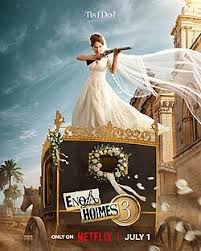
A Continental Shift for the Holmes Legacy: An In-Depth Review of Netflix’s Enola Holmes 3 (2026)
The evolution of a franchise often hinges on its ability to mature alongside its protagonist. With Enola Holmes 3 (2026), Netflix and Legendary Pictures deliver a strikingly ambitious third act that steers the Victorian-era mystery series into deeper, more precarious waters. Directed by Philip Barantini—taking over the reins from Harry Bradbeer—and scripted once again by Jack Thorne, this installment pivots from the soot-stained streets of industrial London to the sun-bleached, limestone fortresses of Malta.
Adapting the fundamental spirit of Nancy Springer’s The Enola Holmes Mysteries while forging an entirely original narrative path, the film clocks in at a precise 105 minutes. It balances high-society romantic milestones with a geopolitical kidnapping plot that redefines the stakes for the entire Holmes family.
Enola Holmes 3 (2026): Production and Release Overview
| Attribute | Details |
| Title | Enola Holmes 3 |
| Release Date | July 1, 2026 |
| Director | Philip Barantini |
| Screenplay | Jack Thorne |
| Based On | The Enola Holmes Mysteries by Nancy Springer |
| Runtime | 105 Minutes |
| MPAA Rating | PG-13 (for some violence and thematic material) |
| Cinematography | Matthew Lewis |
| Music By | Aaron May, David Ridley |
| Lead Cast | Millie Bobby Brown, Louis Partridge, Henry Cavill, Himesh Patel, Helena Bonham Carter, Sharon Duncan-Brewster, Jason Watkins |
Full Plot Synopsis: A Mediterranean Traitor and a Brother Missing
Enola Holmes 3 opens on the precipice of a massive personal milestone. Having established her independent detective agency in London and navigated the complex social hierarchies of the era, Enola Holmes (Millie Bobby Brown) has finally accepted a marriage proposal from her long-term confidant and intellectual equal, Lord Tewkesbury (Louis Partridge). To avoid the suffocating glare of the London press and the restrictive scrutiny of high-society expectations, the couple plans an exquisite destination wedding in the historic capital of Valletta, Malta.
The gathering of the Holmes inner circle on the Mediterranean island initially carries the warmth of a hard-won victory. Enola’s radical, free-spirited mother Eudoria (Helena Bonham Carter) makes a quiet, untraceable appearance. Sherlock Holmes (Henry Cavill) arrives looking noticeably more grounded, accompanied by his pragmatic new flatmate and associate, Dr. John Watson (Himesh Patel). With the inclusion of an aristocratic advisor, Cambridge (Peter Winfield), and an influential political figure played by Jason Watkins, the wedding promises to be an intersection of familial love and strategic diplomacy.
However, the celebratory atmosphere shatters on the eve of the wedding. Dr. Watson arrives at Enola’s quarters with harrowing news: Sherlock Holmes has vanished entirely from his secured lodgings. A sweep of the room reveals no signs of a struggle, but rather a trail of hyper-specific, fragmented intellectual clues that only another Holmes could decipher. The festive mood dissolves instantly. The threat materializes fully when a message confirms the involvement of Mira Troy, the brilliant, vengeful criminal mastermind better known as Moriarty (Sharon Duncan-Brewster), who has escaped custody and fled to the continent.
Moriarty’s scheme is far more insidious than simple retribution against her great rival. By orchestrating Sherlock’s abduction within a strategic British military hub like Malta, she intends to manipulate regional political treaties, placing Sherlock on a literal ticking clock as a high-stakes geopolitical pawn.
Refusing to let the authorities mishandle the investigation, Enola postpones her wedding day and plunges into the labyrinthine, ancient streets of Mdina and Valletta. Accompanied by a deeply supportive Tewkesbury—who utilizes his status in the House of Lords to navigate diplomatic roadblocks—and the tactical, methodical mind of Dr. Watson, Enola must decipher Moriarty’s architectural puzzles. The narrative transforms into an intense, cross-island race against time, forcing Enola to bridge the gap between her personal aspirations for a shared life and her intrinsic moral duty to save her brother.
Detailed Film Critique
Themes: The Cost of Autonomy and the Evolution of Partnerships
The thematic spine of Enola Holmes 3 centers on the reconciliation of individual freedom with emotional commitment. Throughout the first two entries, Enola’s primary objective was carving out a space for herself outside of her brothers’ shadows and the rigid expectations of Victorian womanhood. Here, Thorne’s screenplay introduces a mature dilemma: how does a fiercely independent woman preserve her agency while entering the shared institution of marriage? The impending union with Tewkesbury is treated not as a traditional fairy-tale ending, but as an ongoing negotiation between two distinct, powerful identities.
Additionally, the film examines the emotional evolution of the Holmes men. Sherlock’s sudden vulnerability and subsequent reliance on both his sister and Dr. Watson serves as a profound deconstruction of his typical isolation. The story argues that intellect without human connection is inherently vulnerable to the cold calculation of figures like Moriarty.
Direction: Philip Barantini’s Kinetic Realism
The most radical shift in the film stems from director Philip Barantini, making this the first entry in the franchise not helmed by Harry Bradbeer. Barantini, widely recognized for his pressure-cooker tension in works like Boiling Point, strips away some of the more theatrical, cartoonish flourishes of the previous films.
While Enola’s iconic fourth-wall breaks remain intact, Barantini treats them as brief, urgent internal monologues rather than casual, comedic asides. He maintains a relentless narrative momentum that matches the film’s shortened 105-minute runtime. Barantini’s background in high-stress pacing is highly effective during the film’s climax, transforming historical fortifications into claustrophobic spaces of genuine peril.
Performances and Character Dynamics
Millie Bobby Brown delivers her most accomplished portrayal of Enola yet. She retains the physical comedy and sharp-tongued wit that defined the character’s appeal, but strips away the adolescence; when faced with the genuine prospect of losing her brother, Brown grounds the performance with a palpable, stakes-driven gravity.
Henry Cavill provides an exceptionally humanized Sherlock Holmes, playing him with an underlying warmth and protective instinct that contrasts beautifully with his analytical brilliance. The introduction of Himesh Patel as Dr. John Watson is an absolute triumph for the franchise. Patel avoids the cliché of the bumbling sidekick, instead infusing Watson with a quiet, observant dignity and practical military discipline that immediately solidifies his chemistry with Cavill.
                  [Moriarty] (Antagonist)
                      |
                      v
[Enola Holmes] <=============> [Sherlock Holmes]
      ^                               ^
      | (Fiancé)                      | (Partner)
      v                               v
[Lord Tewkesbury]              [Dr. John Watson]
Louis Partridge continues to be an exceptional anchor for Enola’s emotional arc. His Tewkesbury remains entirely supportive without ever feeling passive, actively engaging in the physical and intellectual demands of the investigation. Sharon Duncan-Brewster handles Moriarty with an icy, smiling precision, establishing herself as an ideological mirror to the Holmes intellect.
Visuals, Cinematography, and Score
Cinematographer Matthew Lewis completely reimagines the visual palette of the series. By moving away from the foggy, industrial grey-and-amber aesthetic of Victorian London, Lewis leverages Malta’s blinding white limestone architecture, deep sapphire coastlines, and harsh, unyielding sunlight. This daylight noir approach means that threats do not hide in dark alleys but out in the open, framed against centuries-old bastions.
The orchestral score by Aaron May and David Ridley mirrors this shift. They discard the whimsical, bouncy melodies of the earlier films, introducing a driving, percussive musical landscape that emphasizes the relentless nature of Moriarty’s countdown.
Strengths & Weaknesses
Strengths
-
Focused Runtime: At 105 minutes, the film eliminates unnecessary subplots, delivering the most streamlined, tightly paced entry in the trilogy.
-
The Watson Dynamics: Himesh Patel’s debut as Dr. John Watson injects a compelling, mature energy into the franchise’s traditional character dynamics.
-
Stunning Aesthetic Reconfiguration: The Maltese setting provides a brilliant cinematic scope, elevating the production value and offering a fresh atmospheric identity.
-
Nuanced Performance Scale: The evolution of the relationship between Brown and Cavill anchors the high-stakes narrative in authentic familial emotion.
Weaknesses
-
Marginalized Supporting Characters: Due to the relentless pacing and shift in geography, beloved recurring figures—most notably Helena Bonham Carter’s Eudoria Holmes—are restricted to minimal screen time.
-
Tonally Darker Footing: Viewers who deeply preferred the lighthearted, cozy Victorian whimsy of the original entries might find the thriller-forward, stakes-heavy tone a jarring transition.
Final Verdict
Enola Holmes 3 marks a triumphant, necessary evolution for the franchise. Rather than repeating the formula of localized London scandals, the film expands its physical and thematic horizons. Philip Barantini successfully balances the core characteristics that made Enola a fan favorite while steering the production into a sleeker, more sophisticated cinematic space. Fueled by a brilliant ensemble cast and a fiercely intelligent script by Jack Thorne, it stands as a standout entry that honors its origins while moving confidently toward maturity.
Final Score: 4.5 / 5 Stars